ads1

Tampilkan postingan dengan label Academic Articles. Tampilkan semua postingan

Jumat, 09 Juni 2023

The Fed and the Phillips curve


I just finished a new draft of "Expectations and the neutrality of interest rates," which includes some ruminations on inflation that may be of interest to blog readers. 

A central point of the paper is to ask whether and how higher interest rates lower inflation, without a change in fiscal policy. That's intellectually interesting, answering what the Fed can do on its own. It's also a relevant policy question. If the Fed raises rates, that raises interest costs on the debt. What if Congress refuses to tighten to pay those higher interest costs? Well, to avoid a transversality condition violation (debt that grows forever) we get more inflation, to devalue outstanding debt. That's a hard nut to avoid.  

But my point today is some intuition questions that come along the way. An implicit point: The math of today's macro is actually pretty easy. Telling the story behind the math, interpreting the math, making it useful for policy, is much harder. 

1. The Phillips curve

The Phillips curve is central to how the Fed and most policy analysts think about inflation. In words, inflation is related to expected future inflation and by some measure if economic tightness, factor \(x\). In equations, \[ \pi_t = E_t \pi_{t+1} + \kappa x_t.\] Here \(x_t\) represents the output gap (how much output is above or below potential output), measures of labor market tightness like unemployment (with a negative sign), or labor costs. (Fed Governor Chris Waller has a great speech on the Phillips curve, with a nice short clear explanation. There are lots of academic explanations of course, but this is how a sharp sitting member of the FOMC thinks, which is what we want to understand. BTW, Waller gave an even better speech on climate and the Fed. Go Chris!)  

So how does the Fed change inflation? In most analysis, the Fed raises interest rates; higher interest rates cool down the economy lowering factor x; that pushes inflation down. But does the equation really say that? 

This intuition thinks of the Phillips curve as a causal relation, from right to left. Lower \(x\) causes lower inflation. That's not so obvious. In one story, the Phillips curve represents how firms set prices, given their expectation of other's prices and costs. But in another story, aggregate demand raises prices, and that causes firms to hire more (Chris Waller emphasized these stories). 

This reading may help to digest an otherwise puzzling question: Why are the Fed and its watchers so obsessed with labor markets? This inflation certainly didn't start in labor markets, so why put so much weight on causing a bit of labor market slack? Well, if you read the Phillips curve from right to left, that looks like the one lever you have. Still, since inflation clearly came from left to right, we still should put more emphasis in curing it that way. 

2. Adjustment to equilibrium vs. equilibrium dynamics. 

But does the story work? Lower \(x_t\) lowers inflation \(\pi_t\) relative to expected future inflation \(E_t \pi_{t+1}\). Thus, it describes inflation that is rising over time.  This does not seem at all what the intuition wants. 

So how do we get to the intuition that lower \(x_t\) leads to inflation got goes down over time?  (This is on p. 16 of the paper by the way.) An obvious answer is adaptive expectations: \(E_t \pi_{t+1} = \pi_{t-1}\).  Then lower \(x_t\) does mean inflation today lower than it was in the past. But the Fed and most commenters really don't want to go there. Expectations may not be "rational," and in most commentary they are either "anchored" by faith in the Fed, or  driven by some third force. But they aren't mechanically last year's inflation. If they were, we would need much higher interest rates to get real interest rates above zero. Perhaps the intuition comes from remembering these adaptive expectations dynamics, and not realizing that the new view that expectations are forward looking, even if not rational, undermines those dynamics. 

Another answer  may be confusion between adjustment to equilibrium and movement of equilibrium inflation over time. Lower \(x_t\) means lower inflation \(\pi_t\) than would otherwise be the case. But that  reduction is an adjustment to equilibrium. It's not how inflation we observe -- by definition, equilibrium inflation -- evolves over time. 

This is, I think, a common confusion. It's not always wrong. In some cases, adjustment to equilibrium does describe how an equilibrium quantity changes, and in a more complex model that adjustment plays out as a movement over time. For example, a preference or technology shock might give a sudden increase in capital; add adjustment costs and capital increases slowly over time. A fiscal shock or money supply shock gives a sudden increase in the price level; add sticky prices and you get a slow increase in the price level over time. 

But we already have sticky prices. This is supposed to be the model, the dynamic model, not a simplified model. Here, inflation lower than it otherwise would be is not the same thing as inflation that goes down slowly over time. It's just a misreading of equations. 

Another possibility is that verbal intuition refers to the future, \[ E_t \pi_{t+1} = E_t \pi_{t+2} + \kappa E_t x_{t+1} .\]Now, perhaps, raising interest rates today lowers future factor x, which then lowers future inflation \(E_t\pi_{t+1}\) relative to today's inflation \(\pi_t\). That's still a stretch however. First, the standard new-keynesian model does not have such a delay. \[x_t = E_t x_{t+1} - \sigma(i_t - E_t \pi_{t+1})\]says that higher interest rates also immediately lower output, and lower output relative to future output. Higher interest rates also raise output growth. This one is more amenable to adding frictions -- habits, capital accumulation, and so forth -- but the benchmark model not only does not have long and variable lags, it doesn't have any lags at all.  Second, maybe we lower inflation \(\pi_{t+1}\) relative to its value \(\pi_t\), in equilibrium, but we still have inflation growing from \(t+1\) to \( t+2\). We do not have inflation gently declining over time, which the intuition wants. 

We are left -- and this is some of the point of my paper -- with a quandary. Where is a model in which higher interest rates lead to inflation that goes down over time? (And, reiterating the point of the paper, without implicitly assuming that fiscal policy comes to the rescue.) 

3. Fisherian intuition

A famous economist, who thinks largely in the ISLM tradition, once asked me to explain in simple terms just how higher interest rates might raise inflation. Strip away all price stickiness to make it simple, still, the Fed raises interest rates and... now what? Sure point to the equation \( i_t = r + E_t\pi_{t+1} \) but what's the story? How would you explain this to an undergraduate or MBA class?  I fumbled a bit, and it took me a good week or so to come up with the answer. From p. 15 of the paper, 

First,  consider the full consumer first-order condition \[x_t = E_t x_{t+1} - \sigma(i_t -E_t \pi_{t+1})\] with no pricing frictions.  Raise the nominal interest rate \(i_t\).  Before prices change, a higher nominal interest rate is a higher real rate, and induces people  to demand less today \(x_t\) and more next period \(x_{t+1}\).  That change in demand pushes down the price level today \(p_t\) and hence current inflation \(\pi_t = p_t - p_{t-1}\), and it pushes up  the expected price level next period \(p_{t+1}\) and thus expected future inflation \(\pi_{t+1}=p_{t+1}-p_t\). 

So, standard intuition is correct, and refers to a force that can lower current inflation. Fisherian intuition is correct too, and refers to a natural force that can raise expected future inflation. 

But which is it, lower \(p_t\) or higher \(p_{t+1}\)? This consumer first-order condition, capturing an  intertemporal substitution effect, cannot tell us. Unexpected inflation and the overall price level is determined by a wealth effect. If we pair the higher interest rate with no change in surpluses, and thus no wealth effect, then the initial price level \(p_t\) does not change [there is no devaluation of outstanding debt] and the entire effect of higher interest rates is a rise in \(p_{t+1}\).  A concurrent rise in expected surpluses leads to a lower price level \(p_t\) and less current inflation \(\pi_t\). Thus in this context standard intuition also implicitly assumes that fiscal policy acts in concert with monetary policy. 

In both these stories, notice how much intuition depends on describing how equilibrium forms. It's not rigorous. Walrasian equilibrium is just that, and does not come with a price adjustment process. It's a fixed point, the prices that clear markets, period. But believing and understanding how a model works needs some sort of equilibrium formation story. 

4. Adaptive vs. rational expectations 

The distinction between rational, or at least forward-looking and adaptive or backward-looking expectations is central to how the economy behaves. That's a central point of the paper.  It would seem easy to test, but I realize it's not. 

Writing in May 2022, I thought about adaptive (backward-looking) and rational (forward-looking), and among other points that under adaptive expectations we need nominal interest rates above current inflation  -- i.e. much higher -- to imply real interest rates, while that isn't necessarily true with forward-looking expectations. You might be tempted to test for rational expectations, or look at surveys to pronounce them "rational" vs. "behavioral," a constant temptation. I realize now it's not so easy (p. 44): 

Expectations may seem adaptive.  Expectations must always be, in equilibrium, functions of variables that people observe, and likely weighted to past inflation. The point of "rational expectations'' is that those forecasting rules are likely to change as soon as a policy maker changes policy rules, as Lucas  famously pointed out in his "Critique."  Adaptive expectations may even be model-consistent [expectations of the model equal expectations in the model] until you change the model.

That observation is important in the current policy debate. The proposition that interest rates must be higher than current inflation in order to lower inflation assumes that expected inflation equals current inflation -- the simple one-period lagged adaptive expectations that I have specified here. Through 2021-2022, market and survey expectations were much lower than current (year on year) inflation. Perhaps that means that markets and surveys have rational expectations: Output is temporarily higher than the somewhat reduced post-pandemic potential, so inflation is higher than expected future inflation (\(\pi_t = E_t \pi_{t+1} + \kappa x_t\)). But that observation could also mean that inflation expectations are a long slow-moving average of lagged inflation, just as Friedman speculated in 1968 (\(\pi^e_t = \sum_{j=1}^\infty \alpha_j \pi_{t-j}\)). In either case, expected inflation is much lower than current inflation, and interest rates only need to be higher than that low expectation to reduce inflation. Tests are hard, and you can't just look at in-sample expectations to proclaim them rational or not. 

Rational expectations change when policy deviates from a rule, or when the policy rule changes. That's their key feature. We should talk perhaps about rational vs. exogenous expectations. 

5. A few final Phillips curve potshots

It is still a bit weird that so much commentary is so focused on the labor market to judge pressure on inflation. This inflation did not come from the labor market! 

Some of this labor market focus makes sense in the new-Keynesian interpretation of the Phillips curve: Firms set prices based on expected future prices of their competitors and marginal costs, which are largely labor costs. That echoes the 1960s "cost push" view of inflation (as opposed to its nemesis "demand pull" inflation). But it begs the question, well, why are labor costs going up? The link from interest rates to wages is about as direct as the link from interest rates to pries. This inflation did not come from labor costs, maybe we should fix the actual problem? Put another way, the Phillips curve is not a model. It is part of a model, and lots of equations have inflation in them. Maybe our focus should be elsewhere. 

Back to Chris Waller, whose speech seems to me to capture well sophisticated thinking at the Fed.  Waller points out how unreliable the Phillips curve is 

What do economic data tell us about this relationship? We all know that if you simply plot inflation against the unemployment rate over the past 50 years, you get a blob. There does not appear to be any statistically significant correlation between the two series.


In more recent years, since unemployment went up and down but inflation didn't go far, the Phillips curve seemed "flat," 

the Phillips curve was very flat for the 20-plus years before the pandemic, 

You can see this in the decline of unemployment through 2020, as marked, with no change in inflation. Then, unemployment surged in 2021, again with no deflation.  2009 was the last time there was any slope at all to the Phillips curve. 

But is it "flat" -- a stable, exploitable, flat relationship -- or is it just a stretched out "blob", two series with no stable relationship, one of which just got stable? 

In any case, as unemployment went back down to 3.5 percent in 2022, inflation surged. You can forgive the Fed a bit: We had 3.5% unemployment with no inflation in 2020, why should we worry about 3.5% unemployment in 2022? I think the answer is, because inflation is driven by a whole lot more than unemployment -- stop focusing on labor markets! 

A flat curve, if it is a curve, is depressing news: 

 Based on the flatness of the Phillips curve in recent decades, some commentators argued that unemployment would have to rise dramatically to bring inflation back down to 2 percent. 

At best, we retrace the curve back to 2021 unemployment. But (I'll keep harping on this), note the focus on the error-free Phillips curve as if it is the entire economic model. 

Waller views the new Phillips curve as a "curve," that has become steeper, and cites confirming evidence that prices are changing more often and thus becoming more flexible.   

... considering the data for 2021... the Phillips curve suddenly looked relatively steep.. since January 2022, the Phillips curve is essentially vertical: The unemployment rate has hovered around 3.6 percent, and inflation has varied from 7 percent (in June) to 5.3 percent (in December).

Waller concludes 

A steep Phillips curve means inflation can be brought down quickly with relatively little pain in terms of higher unemployment. Recent data are consistent with this story.

Isn't that nice -- from horizontal to vertical all on its own, and in the latest data points inflation going straight down. 

Still, perhaps the right answer is that this is still a cloud of coincidence and not the central, causal, structural relationship with which to think about how interest rates affect inflation. 

If only I had a better model of inflation dynamics...


Rabu, 24 Mei 2023

Hoover Monetary Policy Conference Videos

The videos from the Hoover Monetary Policy Conference are now online here.  See my previous post for a summary of the conference. 

The big picture is now clearer to me. Phil Jefferson rightly asked, what do you mean off track? Monetary policy is doing fine. Interest rates are, in his view, where they should be. He argued the case well. 

But now I have an answer: The Fed has had three significant institutional failures: 1) Its inflation target is 2%, yet inflation exploded to 8%. The Fed did not forecast it, and did not see it even as it was happening. (Nor did many other forecasters, pointing to deeper conceptual problems.) 2) In the SVB and subsequent mess, the Fed's regulatory apparatus did not see or do anything about plain vanilla interest-rate risk combined with uninsured deposits. 3) I add a third, that nobody else seems to complain about: In 2020 starting with treasury markets, moving on to money market funds, state and local financing,  and then an astonishing "whatever it takes" that corporate bond prices shall not fall, the Fed already revealed that the Dodd-Frank machinery was broken. (Will commercial real estate be next?) 

Yet there is very little appetite for self-examination or even external examination. How did a good institution, filled with good, honest, smart and devoted public servants fail so badly? That's not "off-track" that's a derailment. 

Well, two sessions at the conference begin to ask those questions, and the others aimed at the same issues. Hopefully they will prod the Fed to do so as well, or at least to be interested in other's answers to those questions. 

(My minor contributions: on why the Taylor rule is important here, where I think I did a pretty good job; and comments on why inflation forecasts went so wrong at  1:00:16 here.)

Bradley Prize speech, video, and thanks

The videos and speeches of the Bradley prize winners are up. My video here (Grumpy in a tux!), also the speech which I reproduce below. All the videos and speeches here (Betsy DeVos and Nina Shea) My previous interview with Rick Graeber, head of the Bradley foundation. 

Bradley also made a nice introduction video with photos from my childhood and early career. (A link here to the introduction video and speech together.) And to avoid us spending all our talks on thanking people, they had us write out a separate thanks. That seems not to be up yet, but I include mine below. I am very thankful, humbled to be included in such august company, and not so boorish that I would not have spent my whole talk without mentioning that, absent the separate opportunity to say so. 

Bradley prize remarks (i.e. condense three decades of policy writing into 10 minutes): 

Creeping stagnation ought to be recognized as the central economic issue of our time. Economic growth since 2000 has fallen almost by half compared with the last half of the 20th Century. The average American’s income is already a quarter less than under the previous trend. If this trend continues, lost growth in fifty years will total three times today’s economy. No economic issue — inflation, recession, trade, climate, income diversity — comes close to such numbers.

Growth is not just more stuff, it’s vastly better goods and services; it’s health, environment, education, and culture; it’s defense, social programs, and repaying government debt.

Why are we stagnating? In my view, the answer is simple: America has the people, the ideas, and the investment capital to grow. We just can’t get the permits. We are a great Gulliver, tied down by miles of Lilliputian red tape.  

How much more can the US grow? Looking around the world, we see that even slightly better institutions produce large improvements in living standards. US taxes and regulations are only a bit less onerous than those in Canada and the UK, but US per capita income is 40% greater. Bigger improvements have enormous effects. US per capita income is 350% greater than Mexico’s and 950% greater than India’s. Unless you think the US is already perfect, there is a lot we can do. 

How can we improve the US economy? I offer four examples.

I don’t need to tell you how dysfunctional health care and insurance are. Just look at your latest absurd bill. 

There is no reason that health care cannot be provided in the same way as lawyering, accounting, architecture, construction, airplane travel, car repair, or any complex personal service. Let a brutally competitive market offer us better service at lower prices. There is no reason that health insurance cannot function at least as well as life, car, property, or other insurance. It’s easy to address standard objections, such as preexisting conditions, asymmetric information, and so on.

How did we get in this mess? There are two original sins. First, in order to get around wage controls during WWII, the government allowed a tax deduction for employer-based group plans, but not for portable insurance. Thus preexisting conditions were born: if you lose your job, you lose health insurance. Patch after patch then led to the current mess. 

Second, the government wants to provide health care to poor people, but without visibly taxing and spending a lot. So, the government forces hospitals to treat poor people below cost, and recoup the money by overcharging everyone else. But an overcharge cannot stand competition, so the government protects hospitals and insurers from competition. You’ll know health care is competitive when, rather than hide prices, hospitals spam us with offers as airlines and cell phone companies do.  

There is no reason why everyone’s health care and insurance must be so screwed up to help the poor. A bit of taxing and spending instead — budgeted, appropriated, visible — would not stymie competition and innovation. 

Example 2: Banking offers plenty of room for improvement. In 1933, the US suffered a great bank run. Our government responded with deposit insurance. Guaranteeing deposits stops runs, but it’s like sending your brother-in-law to Las Vegas with your credit card, what we economists call an “incentive for risk taking.” The government piled on regulations to try to stop banks from taking risks. The banks got around the regulations, new crises erupted, new guarantees and regulations followed. This spring, the regulatory juggernaut failed to detect simple interest rate risk, and Silicon Valley Bank had a run, followed by others. The Fed and FDIC bailed out depositors and promised more rules. 

This system is fundamentally broken. The answer: Deposits should flow to accounts backed by reserves at the Fed, or short-term treasuries. Banks should get money for risky loans by issuing stock or long term debt that can’t run. We can end private-sector financial crises forever, with next to no regulation. 

There is a lesson in these stories. If we want to improve regulations, we can’t just bemoan them. We must understand how they emerged. 

As in health and banking, a regulatory mess often emerges from a continual patchwork, in which each step is a roughly sensible repair of the previous regulation’s dysfunction. The little old lady swallowed a fly, a spider to catch the fly, and so on. Now horse is on the menu. Only a start-from-scratch reform will work.

Much regulation protects politically influential businesses, workers, and other constituencies from the disruptions of growth. Responsive democracies give people what they want, good and hard. And in return, regulation extorts political support from those beneficiaries. We have to fix the regulatory structure, to give growth a seat at the table.  

Economists are somewhat at fault too. They are taught to look at every problem, diagnose “market failure,” and advocate new rules to be implemented by an omniscient, benevolent planner. But we do not live in a free market. When you see a problem, look first for the regulation that caused it.

Example 3: Taxes are a mess, with high marginal rates that discourage work, investment and production; disappointing revenue; and massive, wasteful complexity. How can the government raise revenue while doing the least damage to the economy? A uniform consumption tax is the clear answer. Tax money when people spend it. When earnings are saved, invested, plowed into businesses that produce goods and services and employ people, leave them alone.

Example 4: Bad incentives are again the unsung central problem of our social programs.  Roughly speaking, from zero to about sixty thousand dollars of income, if you earn an extra dollar, you lose a dollar of benefits. Fix the incentives, and more people will get ahead in life. We will also better help the truly needy, and the budget.

Some more general points unite these stories:

Focus on incentives. Politics and punditry are consumed with taking from A to give to B. Incentives are far more important for economic growth, and we can say something objective about them. 

Find the question. Politics and punditry usually advance answers without stating the question, or shop around for questions to justify the same old answers. Most people who disagree with the consumption tax really have different goals than funding the government with minimum economic damage. Well, what do you want the tax system to do? State the question, let’s find the best answer to the question, and we can make a lot of progress.

Look at the whole system. Tax disincentives come from the total difference between the value your additional work creates and what you can consume as a result. Between these lie payroll, income, excise, property, estate, sales, and corporate taxes, and more, at the federal, state, and local level. Greg Mankiw figured his all-in marginal tax rate at 90%, and even he left out sales, property, and a few more taxes. Social-program disincentives come from the combined phaseout of food stamps, housing subsidies, medicaid or Obamacare subsidies, disability payments, tax credits, and so on, down to low-income parking passes. And look at taxes and social programs together. A flat tax that finances checks to worthy people is very progressive government, if you want that. Looking at an individual tax or program for its disincentives or progressivity is silly. 

The list goes on. Horrible public education, labor laws, licensing laws, zoning, building and planning restrictions, immigration restrictions, regulatory barriers, endless lawsuits, prevailing-wage and domestic-content rules, are all sand in the productivity gears. Oh, and I haven’t even gotten to money and inflation yet! 

And that just fixes our current economy. Long-term growth comes from new ideas. Many economists say we have run out of ideas; growth is ending; slice the pie. I look out the window and I see factory-built mini nuclear power plants that the Nuclear Regulatory Commission is strangling; I see a historic breakthrough in artificial intelligence, facing an outcry for the government to stop it. I see advances in biology that portend much better health and longevity, but good luck getting FDA approval or increasingly politicized research funding.

Many conservatives disparage this “incentive economics” as outdated and boring. That attitude is utterly wrong. Incentives, and the freedom, rights, and rule of law that preserve incentives, remain the key to tremendous and widespread prosperity. And it is hard work to understand and fix the incentives behind today’s problems.

Yes, supply is less glamorous than stimulus. “Fix regulations” is a tougher slogan than “free money for voters.” Efficiency requires detailed reform in every agency and market, the Marie-Kondo approach to our civic life. But it’s possible. And we don’t need to reform all the dinosaurs. As we have seen with telephones, airlines, and taxis, we just need to allow new competitors, to allow the buds of freedom to grow.

Many people ask, “How can we get leaders to listen?” That’s the wrong question. Believe in democracy, not bending the emperor’s ear. Take action. My fellow prizewinners have grabbed the levers of influence that belong to citizens of our free society, and done hard work of reforming its institutions. And ideas matter. The Hoover Institution motto is “ideas defining a free society.” The Bradley Foundation tonight celebrates good ideas, and is devoted to spreading them. When voters, media, the chattering classes, and institutions of civil society understand, advance and apply these ideas, politicians will swiftly follow.   

Notes:

Growth: Real GDP 1950:I was $2186 billion, and per capita $14500; in 2000:I, $12935 and per capita $45983; in 2022:IV, $20182 and per capita 60376. From these numbers, average log real GDP growth 1950-2000 was 3.56% From 2000-2002, 1.96%. In per capita terms,  2.31% and  1.20%. (2.31-1.20)x22 = 24.4. 

Cross-country comparison: Calculations based on purchasing-power-adjusted GDP per capita: US $69,287, Canada $52,790, UK $50,890, Mexico $19,587, India $7,242. Source: https://data.worldbank.org/indicator/NY.GDP.PCAP.PP.CD The PPP adjustment tries to take account that some things are cheaper in other countries. Converting at the exchange rate produces even larger differences. US $70.248, Canada $51,987, UK $46,510, Mexico $10,065, India $2,256. Source: https://data.worldbank.org/indicator/NY.GDP.PCAP.CD

Mankiw: http://www.nytimes.com/2010/10/10/business/economy/10view.html

Thanks

I have been fortunate to benefit from the effort, time, wisdom and affection of so many people, and many institutions that supported their efforts.

Of course it starts with my parents, Eric and Lydia Cochrane. They expected children to think and speak at the family dinner table. They exposed me to different cultures, on the south side of Chicago and in Italy, sometimes beyond my desires. They set an example by how they lived: They steadfastly followed their intellectual pursuits with extreme honesty. They treated people with a radical egalitarianism. And then left me alone to pursue my own passions. 

I was lucky to learn from some extraordinary and dedicated teachers, at the Ancona Montessori School, the U of C Lab school, Italian public schools, and Kenwood high school. There, in an inner city public school, Arlene Gordon (Math), Judith Stein (English) Walter Sherrill (Chemistry) and especially Joel Hofslund (Physics) gave me absolutely first rate experience. Thanks also to Ed Shands’ patient coaching of our swim team. 

I moved on to MIT to study physics. This was more impersonal, and a difficult time for me, but as it turned out a superb education in the kind of mathematical modeling essential to economics. 

I went on to study economics at the University of California at Berkeley. Faculty took PhD teaching seriously, not just of their own research, and I soaked it up. I thank especially my advisers, Roger Craine, Tom Rothermberg, and George Akerlof.  Many of their lessons are vivid today, but like my parents they provided only gentle guidance and feedback on my own imperfect quests. 

I was supremely luck to land a job at the University of Chicago. I learned a tremendous amount in the wide open collegial atmosphere at Chicago, thanks in large part to Lars Hansen and Gene Fama, but also colleagues too numerous to mention in this short space.  Generations of MBA and PhD students also pushed me hard to understand economics and became lifelong friends and colleagues. 

At just the right moment Hoover came calling, allowing me the time and institutional support to blossom as a public intellectual and commenter as well as an academic. A special thanks to John Raisin for that. 

No man is an island. The world of ideas is a conversation. Everything I know has been shaped by teachers, friends, colleagues, collaborators, students, journal editors, referees, and others who took the time and effort to help me think about things. 

Many small interactions have had a crucial effect on my life. A coffee conversation at a conference with John Campbell resulted in our best known academic paper. A lunch conversation with Luigi Zingales produced my first public writing during the financial crisis. As a result, Amity Shlaes invited me to a conference. Howard Dickman, then at the Wall Street Journal, liked my presentation and asked, “Why don’t you write opeds for us?” I answered, “Why don’t you stop rejecting them?” My oped career was born. And so forth. I thank these and many more, and lady luck who put us together. 

Of course my greatest thanks go to my wonderful wife, Elizabeth Fama. We met the night I returned to Chicago. It was love at first sight. We were engaged on the second date. She has been my best friend and constant companion ever since, though marriage to a passionate researcher, busy teacher and lover of time consuming sports cannot have been easy. Together we raised four amazing children, Sally, Eric, Jean, and Lake, who fill my heart with love, and now that they are grown a bit of nostalgia. 


Rabu, 17 Mei 2023

Bob Lucas and his papers

My first post described a few anecdotes about what a warm person Bob Lucas was, and such a great colleague. Here I describe a little bit of his intellectual influence, in a form that is I hope accessible to average people.

The “rational expectations” revolution that brought down Keynesianism in the 1970s was really much larger than that. It was really the “general equilibrium” revolution. 

Macroeconomics until 1970 was sharply different from regular microeconomics. Economics is all about “models,” complete toy economies that we construct via equations and in computer programs. You can’t keep track of everything in even the most beautiful prose. Microeconomic models, and “general equilibrium” as that term was used at the time, wrote down how people behave — how they decide what to buy, how hard to work, whether to save, etc.. Then it similarly described how companies behave and how government behaves. Set this in motion and see where it all settles down; what prices and quantities result. 

But for macroeconomic issues, this approach was sterile. I took a lot of general equilibrium classes as a PhD student — Berkeley, home of Gerard Debreu was strong in the field. But it was devoted to proving the existence of equilibrium with more and more general assumptions, and never got around to calculating that equilibrium and what it might say about recessions and government policies. 

Macroeconomics, exemplified by the ISLM tradition,  inhabited a different planet. One wrote down equations for quantities rather than people, for example that “consumption” depended on “income,” and investment on interest rates. Most importantly, macroeconomics treated each year as a completely separate economy. Today’s consumption depended on today’s income, having nothing to do with whether people expected the future to look better or worse. Economists recognized this weakness, and a vast and now thankfully forgotten literature tried fruitlessly to find “micro foundations” for Keynesian economics. But building foundations under an existing castle doesn’t work. The foundations want a different castle. 

Bob’s “islands” paper is famous, yes, for a complete model of how unexpected money might move output in the short run and not just raise inflation. But you can do that with a half a page of simple math, and Bob’s paper is hard to read. It’s deeper contribution, and the reason for that difficulty, is that Bob wrote out a complete “general equilibrium” model. People, companies and government each follow described rules of behavior. Those rules are derived as being the optimal thing for people and companies to do given their environment. And they are forward-looking. People think about how to make their whole lives as pleasant as possible, companies to maximize the present value of profits. Prices adjust so supply = demand. Bob said, by example, that we should do macroeconomics by writing down general equilibrium models. 

General equilibrium had also been abandoned by the presumption that it only studies perfect economies. Macroeconomics is really about studying how things go wrong, how “frictions” in the economy, such as the “sticky” wages underlying Keynesian thinking, can produce undesirable and unnecessary recessions. But here too, Bob requires us to write down the frictions explicitly. In his model, people don’t see the aggregate price level right away, and do the best they can with local information. 

That is the real influence of the paper  and Bob’s real influence in the profession. (Current macroeconomic modeling reflects the fact that the Fed sets interest rates, and does not control the money supply.) You can see this influence in Tom Sargent’s textbooks. The first textbook has an extensive treatment of Keynesian economics. It’s about the most comprehensible treatment there is — but it is no insult to Tom to say that in that book you can see how Keynesian economics really doesn’t hang together. Tom describes how, the minute he learned from Bob how to to general equilibrium, everything changed instantly. Rational expectations was, like any other advance, a group effort. But what made Bob the leader was that he showed the rest how to do general equilibrium. 

This is the heart of my characterization that Bob is the most important macroeconomist of the 20th century. Yes, Keynes and Friedman had more policy impact, and Friedman’s advocacy of free markets in microeconomic affairs is the most consequential piece of 20th century economics. But within macroeconomics, there is before Lucas and after Lucas.  Everyone today does economics the Lucas way. Even the most new-Keynesian article follows the Lucas rules of how to do economics. 

Once you see models founded on complete descriptions of people, businesses, government, and frictions, you can see the gaping holes in standard ISLM models. This is some of his stinging critique, such as “after Keynesian macroeconomics.” Sure, if people’s income goes up they are likely to consume more, as the Keynesians posited. But interest rates, wages, and expectations of the future also affect consumption, which Keynesians leave out. “Cross equations restrictions” and “budget constraints” are missing. 

Now, the substantive prediction that monetary policy can only move the real economy via unexpected money supply growth did not bear out, and both subsequent real business cycles and new-Keynesianism brought persistent responses. But the how we do macroeconomics part is the enduring contribution. 

The paper still had enduring practical lessons. Lucas, together with Friedman and Phelps brought down the Phillips curve. This curve, relating inflation to unemployment, had been (and sadly, remains) at the center of macroeconomics. It is a statistical correlation, but like many correlations people got enthused with it and started reading it as stable relationship, and indeed a causal one. Raise inflation and you can have less unemployment. Raise unemployment in order to lower inflation. The Fed still thinks about it in that causal way. But Lucas, Friedman, and Phelps bring a basic theory to it, and thereby realize it is just a correlation, which will vanish if you push on it. Rich guys wear Rolexes. That doesn’t mean that giving everyone a Rolex will have a huge “multiplier” effect and make us all rich. 

This is the essence of the “Lucas critique” which is a second big contribution that lay readers can easily comprehend. If you push on correlations they will vanish. Macroeconomics was dedicated to the idea that policy makers can fool people. Monetary policy might try to boost output in a recession with a surprise bit of money growth. That will wok once or twice. But like the boy who cried wolf, people will catch on, come to expect higher money growth in recessions and the trick won’t work anymore. 

Bob showed here that all the “behavioral” relations of Keynesian models will fall apart if you exploit them for policy, or push on them, though they may well hold as robust correlations in the data. The “consumption function” is the next great example. Keynesians noticed that when income rises people consume more, so write a consumption function relating consumption to income. But, following Friedman’s great work   on consumption, we know that correlation isn’t always true in the data. The relation between consumption and income is different across countries (about one for one) than it is over time (less than one for one). And we understand that with Friedman’s theory: People, trying to do their best over their whole lives don’t follow mechanical rules. If they know income will fall in the future, they consume a lot less today, no matter what today’s current income. Lucas showed that people who behave this sensible way will follow a Keynesian consumption function, given the properties of income overt the business cycle. You will see a Keynesian consumption function. Econometric estimates and tests will verify a Keynesian consumption function. Yet if you use the model to change policies, the consumption function will evaporate. 

This paper is devastating. Large scale Keynesian models had already been constructed, and used for forecasting and policy simulation. It’s natural. The model says, given a set of policies (money supply, interest rates, taxes, spending) and other shocks, here is where the economy goes. Well, then, try different policies and find ones that lead to better outcomes. Bob shows the models are totally useless for that effort. If the policy changes, the model will change. Bob also showed that this was happening in real time. Supposedly stable parameters drifted around. (This one is also very simple mathematically. You can see the point instantly. Bob always uses the minimum math necessary. If other papers are harder, that’s by necessity not bravado.) 

This devastation is sad in a way. Economics moved to analyzing policies in much simpler, more theoretically grounded, but less realistic models. Washington policy analysis sort of gave up. The big models lumber on, the Fred’s FRBUS for example, but nobody takes the policy predictions that seriously. And they don’t even forecast very well. For example, in the 2008 stimulus, the CEA was reduced to assuming a back of the envelope 1.5 multiplier, this 40 years after the first large scale policy models were constructed. Bob always praised the effort of the last generation of Keynesians to write explicit quantitative models, to fit them to data, and to make numerical predictions of various policies. He hoped to improve that effort. It didn’t work out that way, but not by intention. 

This affair explains a lot of why economists flocked to the general equilibrium camp. Behavioral relationships, like what fraction of an extra dollar of income you consume, are not stable over time or as policy changes. But one hopes that preferences, — how impatient you are, how much you are willing to save more to get a better rate of return — and technology — how much a firm can produce with given capital and labor — do not change when policy changes. So, write models for policy evaluation at the level of preferences and technology, with people and companies at the base, not from behavioral relationships that are just correlations. 

Another deep change: Once you start thinking about macroeconomics as intertemporal economics — the economics that results from people who make decisions about how to consume over time, businesses make decisions about how to produce this year and next — and once you see that their expectations of what will happen next year, and what policies will be in place next year are crucial, you have to think of policy in terms of rules, and regimes, not isolated decisions. 

The Fed often asks economists for advice, “should we raise the funds rate?” Post Lucas macroeconomists answer that this isn’t a well posed question. It’s like saying “should we cry wolf?” The right question is, should we start to follow a rule, a regime, should we create an institution, that regularly and reliably raises interest rates in a situation like the current one? Decisions do not live in isolation. They create expectations and reputations. Needless to say, this fundamental reality has not soaked in to policy institutions. And that answer (which I have tried at Fed advisory meetings) leads to glazed eyes. John Taylor’s rule has been making progress for 30 years trying to bridge that conceptual gap, with some success.  

This was, and remains, extraordinarily contentious. 50 years later, Alan Blinder’s book, supposedly about policy, is really one long snark about how terrible Lucas and his followers are, and how we should go back to the Keynesian models of the 1960s. 

Some of that contention comes back to basic philosophy.  The program applies standard microeconomics: derive people’s behaviors as the best thing they can do given their circumstances. If people pick the best combination of apples and bananas when they shop, then also describe consumption today vs. tomorrow as the best they can do given interest rates. But a lot of economics doesn’t like this “rational actor” assumption. It’s not written in stone, but it has been extraordinarily successful. And it imposes a lot of discipline. There are a thousand arbitrary ways to be irrational.  Somehow though, a large set of economists are happy to write down that people pick fruit baskets optimally, but don’t apply the same rationality to decisions over time, or in how they think about the future. 

But “rational expectations” is really just a humility condition. It says, don’t write models in which the predictions of the model are different from the expectations in the model. If you do, if your model is right, people will read the model and catch on, and the model won’t work anymore. Don’t assume you economist (or Fed chair) are so much less behavioral than the people in your model. Don’t base policy on an attempt to fool the little peasants over and over again. It does not say that people are big super rational calculating machines. It just says that they eventually catch on. 

Some of the contentiousness is also understandable by career concerns. Many people had said “we should do macro seriously like general equilibrium.” But it isn’t easy to do. Bob had to teach himself, and get the rest of us to learn, a range of new mathematical  and modeling tools to be able to write down interesting general equilibrium models. A 1970 Keynesian can live just knowing how to solve simple systems of linear equations, and run regressions.  To follow Bob and the rational expectations crowd, you had to learn linear time-series statistics, dynamic programming, and general equilibrium math. Bob once described how tough the year was that it took him to learn functional analysis and dynamic programming. The models themselves consisted of a mathematically hard set of constructions. The older generation either needed to completely retool, fade away, or fight the revolution. 

Some good summary words: Bob’s economics uses"rational expectations,” or at least forward-looking and model-consistent expectations. Economics becomes “intertemporal," not “static” (one year at a time). Economics is “stochastic” as well as “dynamic,” we can treat uncertainty over time, not just economies in which everyone knows the future perfectly. It applies “general equilibrium" to macroeconomics. 

And I’ve just gotten to the beginning of the 1970s. 

When I got to Chicago in the 1980s, there was a feeling of “well, you just missed the party.” But it wasn’t true. The 1980s as well were a golden age. The early rational expectations work was done, and the following real business cycles were the rage in macro. But Bob’s dynamic programming, general equilibrium tool kit was on a rampage all over dynamic economics. The money workshop was one creative use of dynamic programs and interetempboral tools after another one, ranging from taxes to Thai villages (Townsend). 

I’ll mention two. Bob’s consumption model is at the foundation of modern asset pricing. Bob parachuted in, made the seminal contribution, and then left finance for other pursuits. The issue at the time was how to generalize the capital asset pricing model. Economists understood that some stocks pay higher returns than others, and that they must do so to compensate for risk. The understood that the risk is, in general terms, that the stock falls in some sense of bad times. But how to measure “bad times?” The CAPM uses the market, other models use somewhat nebulous other portfolios. Bob showed us that at least in the purest theory, that stocks must pay higher average returns if they fall when consumption falls. (Breeden also constructed a consumption model in parallel, but without this “endowment economy” aspect of Bob’s) This is the purest most general theory, and all the others are (useful) specializations. My asset pricing book follows. 

The genius here was to turn it all around. Finance had sensibly built up from portfolio theory, like supply and demand: Given returns, what stocks do you buy, and how much to you save vs. consume? Then, markets have to clear find the stock prices, and thus returns, given which people will buy exactly the amount that’s for sale and consume what is produced. That’s hard. (Technically, finding the vector of prices that clears markets is hard. Yes, N equations in N unknowns, but they’re nonlinear and N is big.)  

Bob instead imagined that consumption is fixed at each moment in time, like a desert island  in which so many coconuts fall each day and you can't store them or plant them. Then, you can just read prices from people’s preferences. This gives the same answer as if the consumption you assume is fixed had derived from a complex production economy. You don’t have to solve for prices that equate supply and demand. Brilliantly, though prices cause consumption to individual people, consumption causes prices in aggregate. This is part of Bob’s contribution to the hard business of actually computing quantitative models in the stochastic dynamic general equilibrium tradition. 

Bob, with Nancy Stokey also took the new tools to the theory of taxation. (Bob Barro also was a founder of this effort in the late 1980s.) You can see the opportunity: we just learned how to handle dynamic (overt time, expectations of tomorrow matter to what you do today) stochastic (but there is uncertainty about what will happen tomorrow) economics (people make explicit optimizing decisions) for macro. How about taking that same approach to taxes? The field of dynamic public finance is born. Bob and Nancy, like Barro, show that it’s a good idea for governments to borrow and then repay, so as to spread the pain of taxes evenly over time. But not always. When a big crisis comes, it is useful to execute a “state contingent default.” The big tension of Lucas-Stokey (and now, all) dynamic public finance: You don’t want any capital taxes for the incentive effects. If you tax capital, people invest less, and you just get less capital. But once people have invested, a capital tax grabs revenue for the government with no economic distortion. Well, that is, if you can persuade them you’ll never do it again. (Do you see expectations, reputations, rules, regimes, wolves in how we think of policy?) Lucas and Stoney say, do it only very rarely to balance the disincentive of a bad reputation with the need to raise revenue in once a century calamities. 

Bob went on, of course, to be one of the founders of modern growth theory. I always felt he deserved a second Nobel for this work. He’s absolutely right. Once you look at growth, it’s hard to think about anything else. The average Indian lives on $2,000 per year. The average American, $60,000. That was $15,000 in 1950. Nothing else comes close. I only work on money and inflation because that’s where I think I have answers. For us mortals, good research proceeds where you think you have an answer, not necessarily from working on Big Questions. 

Bob brilliantly put together basic facts and theory to arrive at the current breakthrough. Once you get out of the way, growth does not come from more capital, or even more efficiency. It comes from more and better ideas. I remember being awed by his first work for cutting through the morass and assembling the facts that only look salient in retrospect. A key one: Interest rates in poor countries are not much higher than they are in rich countries. Poor countries have lots of workers, but little capital. Why isn’t the return on scarce capital enormous, with interest rates in the hundreds of percent, to attract more capital to poor countries? Well, you sort of know the answer, that capital is not productive in those countries.  Productivity is low, meaning those countries don't make use of better ideas on how to organize production.  

Ideas too are produced by economics, but, as Paul Romer crystallized, they are fundamentally different from other goods. If I produce an idea, you can use it without hurting my use of it. Yes, you might drive down the monopoly profits I gain from my intellectual property. But if you use my Pizza recipe, that’s not like using my car. I can still make Pizza, where if you use my car I can’t go anywhere. Thus, the usual free market presumption that we will produce enough ideas is false. (Don’t jump too quickly to advocate government subsides for ideas. You have to find the right ideas, and governments aren’t necessarily good at subsidizing that search.) And the presumption that intellectual property should be preserved forever is also false. Once produced it is socially optimal for everyone to use it. 

I won’t go on. It’s enough to say that Bob was as central to the creation of idea-based growth theory, which dominates today, as he was to general equilibrium macro, which also dominates today.

Bob is an underrated empiricist. Bob's work on the size distribution of firms (great tweet summary by Luis Garicano) similarly starts from basic facts of the size distribution of firms and the lack of relationship between size and growth rates. It's interesting how we can go on for years with detailed econometric estimates of models that don't get basic facts right. I loved Bob's paper on money demand for the Carnegie Rochester conference series. An immense literature had tried to estimate money demand functions with dynamics, and was pretty confusing. It made a basic mistake, by looking at first differences rather than levels and thereby isolating the noise and drowning out the signal. Bob made a few plots, basically rediscovered cointegration all on his own, and made sense of it all. And don't forget the classic international comparison of inflation-output relations. Countries with volatile inflation have less Phillips curve tradeoff, just as his islands model featuring confusion between relative prices and the price level predicts. 

One last note to young scholars. There is a tendency today to value people by the number of papers they produce, and how quickly they rise through the ranks. Read Bob’s CV. He wrote about one paper a year, starting quite late in life. But, as Aesop said, they were lions. In his Nobel prize speech, Bob also passed on that he and his Nobel-winning generation at Chicago always felt they were in some backwater, where the high prestige stuff was going on at Harvard and MIT. You never know when it might be a golden age. And the AER rejected his islands paper (as well as Akerlof's lemons). If you know it's good, revise and try again. 

I will miss his brilliant papers as much as his generous personality. 

Update: See Ivan Werning's excellent "Lucas Miracles" for an appreciation by a real theorist. 


Selasa, 16 Mei 2023

Hoover Monetary Policy Conference

Friday May 12 we had the annual Hoover monetary policy conference. Hoover twitter stream here.  Conference webpage and schedule here (update 5/24 now contains videos.) As before, the talks, panels, and comments will eventually be written and published. 

The Fed has experienced two dramatic institutional failures: Inflation peaking at 8%, and a rash of bank failures. There were panels focused on each, and much surrounding discussion.  

We started with a little celebration of the 30th anniversary of Taylor (1993), which put the Taylor rule on the map. As Andy Levin pointed out in the discussion, academic immortality comes when they omit the number after your name. Rich Clarida, Volker Weiland and I quickly outlined some academic influence. John Lipsky added some very interesting commentary on how the Taylor rule was important on Wall Street, and specifically from his experience at Salomon Bros. 

The second panel on financial regulation was a smash. Anat Admati chaired, with presentations by Darrell Duffie, Randy Quarles, and Amit Seru. 

Duffie showed how online banking has taken over, and the combination of twitter and online banking makes runs happen much faster than before. You don't have to stand in line, you can all push "withdraw" at once. He also showed a glaring hole in liquidity regulations: A bank cannot count as liquidity its ability to use the discount window at the Fed. 

Seru covered some of his recent work, showing just how many banks have lost 10% or more of their asset value, and thus the value of their equity. (Nobody mentioned commercial real estate, the next shoe to drop.) They gently disagreed, Darrel viewing more liquidity and better liquidity rules as the main solution, and Amit more equity. All seemed to agree that the current regulatory mechanism is fundamentally broken. 

Randy gave a thoughtful, eloquent, and impassioned talk laying to rest the common notion that "deregulation" caused SVB to fail. It would have passed all the stress tests. This will be important to read when the papers are all available. I take the implication that the regulatory structure is, again, fundamentally broken. No, more of the current regulations would not have helped. But Randy didn't say that. 

Peter Henry next presented "Disinflation and the Stock Market: Third World Lessons for First World Monetary Policy" (a paper with Anusha Chari), discussed by Josh Rauh and Chaired by Bill Nelson. A key innovation, they use stock market reactions to measure whether disinflations are a success on a cost/benefit basis. Large inflations seem to end with stock market expansions. Moderate disinflations don't really do much for stock markets. Most disinflationary reforms fail.

Over lunch, Haruhiko Kuroda, Former Governor, Bank of Japan updated us on the Japanese situation. He is confident 2% inflation will return soon. 

Niall Ferguson and Paul Schmelzing presented "The Safety Net: Central Bank Balance Sheets and Financial Crises 1587-2020," (with Martin Kornejew and Moritz Schularick), with Barry Eichengreen discussing and Michael Bordo chair. A taste: 


The paper concludes that lender of last resort operations do work, and also create moral hazard. Barry had an eloquent discussion, noting among other things that not all balance sheet expansions are the same. Look for those in the written versions. 

Next, Mickey Levy presented The Fed: Bad Forecasts and Misguided Monetary Policy, Steve Davis discussing and  Jim Wilcox chair. The Fed -- and most industry analysts -- completely missed 8% inflation, both ahead of time and as it was happening. Why? How can the Fed do better? (And why is the Fed not asking this question?) 


To me, it looks like the forecast is not much more than an AR(1) reversion to 2% inflation. The paper has a good summary of how Fed forecasts are made, along with recommendations for institutional improvement.  

Steve Davis had an excellent discussion, pointing to a central incentive problem. The Fed uses forecasts to try to shape expectations. Like pubic health authorities, it can be afraid to reveal actual fears. I also see conceptual flaws -- not much attention to supply or fiscal policy, using the Phillips curve as a causal model and as a model in itself, too much attention to the one-period link from expected inflation to inflation, and too much attention to the forecast rather than risk management; what do we do if things come out differently. 

The conference day ended with the traditional policy panel, with Jim Bullard (talk here), Philip Jefferson (talk here), Jeff Lacker, and Charlie Plosser, Chaired by John Taylor. 

Bullard pointed to the huge fiscal stimulus as a source of inflation, warming my heart. He opined that this stimulus is fading, making him hopeful for a soft landing. He presented the following chart. 

This is a very interesting measure of how much "stimulus" is sitting out there in the economy. The government did write a lot of checks, that went straight to people's bank accounts, and eventually were spent, driving up inflation. On the other hand, I am still a bit shocked that we're running $1 trillion deficit despite beyond-full employment and output revving at every bit that the "supply" side of the economy can produce. What's your measure of fiscal stimulus? Which forecasts inflation? This is a very provocative and interesting idea. 

Jefferson gave a great talk. He has the measured cadence of a seasoned central banker, but speaks very clearly and directly.  He started by announcing his appointment as vice-chair, which got a well deserved ovation. He then jumped right in: 
The title of the conference "How to Get Back on Track: A Policy Conference" is potent. Its intent and ambiguity are striking. First, the title presupposes that U.S. monetary policy is currently on the wrong track. Second, the webpage for this conference advances a puzzling definition of the phrase "on track." How so? According to the Hoover webpage, "A key goal of the conference is to examine how to get back on track and, thereby, how to reduce the inflation rate without slowing down economic growth" (emphasis added).1 As this audience knows, there are macroeconomic models that permit disinflation with no slowdown in economic growth, but the assumptions underlying these models are very strong. It's not clear, at least to me, why such a strict metric would be used to assess real-world monetary policymaking....

I loved this. It shows he took the time to read up on the conference, and I love seeing basic premises challenged. Later, this struck me as thoughtful: 

I want to share with you a few strategic principles that are important to me. First, policymakers should be ready to react to a wide range of economic conditions with respect to inflation, unemployment, economic growth, and financial stability. The unprecedented pandemic shock is a good reminder that under extraordinary circumstances it will be difficult to formulate precise forecasts in real time. Our dual mandate from the Congress is especially helpful here. It provides the foundation for all our policy decisions. Second, policymakers should clearly communicate monetary policy decisions to the public. Our commitment to transparency should be evident to the public, and monetary policy should be conducted in a way that anchors longer-term inflation expectations. Third—and this is where I am revealing my passion for econometrics—policymakers should continuously update their priors about how the economy works as new data become available. In other words, it is appropriate to change one's perspective as new facts emerge. In this sense, I am in favor of a Bayesian approach to information processing.

The first point brings us back to the problem that the Fed has so far been too silent about: How did it miss 8% inflation? And how to operate when such huge misses are possible? The Fed seems to have been making a forecast, then announcing a policy path that works for the forecast, and then trying to stick to it. In this first principle you see a quite different view. Let's call it data-dependent rather than time-dependent. 

This is a conference about the Taylor rule. Should the Fed look at more than inflation and employment? Well, yes and no according to these comments. And when models are not certain, distrust and update.

Plosser and Lacker previewed an upcoming paper on the Fed's deviation from rules. Stay tuned. 

The evening started with a delightful speech by Sebastian Edwards on Latin American inflation. Stay tuned for that too. 

Videos should be up soon, and written versions as fast as we can get authors to turn them in. This is just a teaser!  

Update: Videos are now up, with some more commentary here.


Senin, 15 Mei 2023

Bob Lucas

I just got the sad news that Bob Lucas has passed away. He was truly a giant among economists, and a wonderful warm person. 

I will only pass on three remembrances that others will not likely mention. 

Bob was incredibly welcoming to me, a young brash and fairly untutored young economist from Berkeley.  

In the fall of 1985 I gave what was no doubt the most disastrous first seminar by a new assistant professor in the Department's history. It was something about random walks and real business cycles, and was going nowhere. Bob stopped by my office, and expressed doubt about this random walk stuff. He said, if you look at longer and longer horizons, GNP volatility goes down. At least I had the wit to recognize what had just been handed to me on a silver platter, dropped everything and wrote the "Random walk in GNP," my first big paper. Without that, I doubt I would be where I am today. Thank you Bob.  He and Nancy were kind to us socially as well. 

The first Lucas paper that I recall reading, while I was still at Berkeley, was his review of a report to the OECD.  I don't think anyone else writing about Bob will mention this masterpiece. If you get annoyed by policy blather, read this article. Reading it as a grad student, I loved the way he sliced through loose prose like warm butter. No BS with Bob. Only clear thinking please. I mentioned it later, and he laughed saying he wrote it in a bad mood because he was getting divorced. Like "After Keynesian Macroeconomics," Bob could wield a pen. 

Much later,  I attended a revelatory money workshop. Bob presented an early version of, I think, "Ideas and growth."  In the model, people have ideas, and bump into each other randomly and share ideas. Questioner after questioner complained that there wasn't any economics in the model. Why not put in some incentive for people to bump in to each other, or something non mechanical. Time after time, Bob answered each suggestion that he had tried it, but it didn't make much difference to the outcome, so he stripped it out of the model. Clearly, he had been playing with this model over a year, working to eliminate  needless ingredients, not to add more generality. It's great to see the production function at work. 

Bob is known as a theorist, but he had a great handle on empirical work as well. His Carnegie Rochester money demand paper basically reinvented cointegration, and saw clearly what dozens of others missed. "Mechanics of economic development" starts by putting together facts. "International evidence on inflation-output tradeoffs" 1973 makes one stunning graph. And more. 

There is so much to say about Bob the great economist, superb colleague and tremendous human being, but I will stop here for now. RIP Bob. And thank you. 

Update:

Ben Moll has a lovely twitter thread about Bob as a thesis adviser. Bob covered Ben's thesis draft with useful comments. Bob read my early papers and did the same thing. This encouraged a culture of comments. Though a young assistant professor, I took it as a duty to write comments on Bob's papers! And some of them actually helped. This was the culture of the economics department in the 1980s, not common. Bob helped quite a few people and JPE authors to see what their papers were really about, making dramatic improvements.  

The outpouring on twitter is remarkable. More remarkable, here is a man for whom we could celebrate every single paper as pathbreaking. Yet the outpouring is all about his wonderful personal qualities. 

A correspondent reminds me of one last story. Bob's divorce agreement specified half of his Nobel prize, which he paid. Asked  by a reporter if he had regrets, he answered "A deal's a deal." 

Next post, focused on intellectual contributions. 

Kamis, 20 April 2023

How do interest rates lower inflation?


A few days ago I gave a short talk on the subject. I was partly inspired by a little comment made at a seminar, roughly "of course we all know that if prices are sticky, higher nominal rates raise higher real rates, that lowers aggregate demand and lowers inflation." Maybe we "know" that, but it's not as readily present in our models as we think. This also crystallizes some work in the ongoing "Expectations and the neutrality of interest rates" project. 

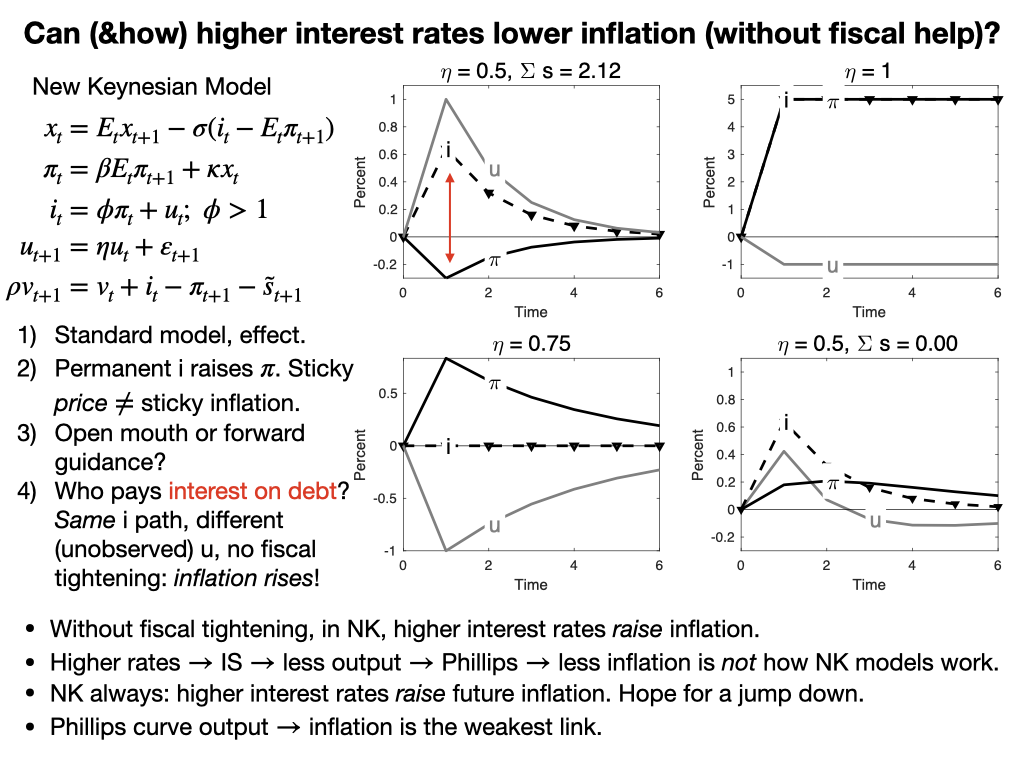
The equations are the utterly standard new-Keynesian model. The last equation tracks the evolution of the real value of the debt, which is usually in the footnotes of that model. 

OK, top right, the standard result. There is a positive but temporary shock to the monetary policy rule, u. Interest rates go up and then slowly revert. Inflation goes down. Hooray. (Output also goes down, as the Phillips Curve insists.) 

The next graph should give you pause on just how you interpreted the first one. What if the interest rate goes up persistently? Inflation rises, suddenly and completely matching the rise in interest rate! Yet prices are quite sticky -- k = 0.1 here. Here I drove the persistence all the way to 1, but that's not crucial. With any persistence above 0.75, higher interest rates give rise to higher inflation. 

What's going on? Prices are sticky, but inflation is not sticky. In the Calvo model only a few firms can change price in any instant, but they change by a large amount, so the rate of inflation can jump up instantly just as it does. I think a lot of intuition wants inflation to be sticky, so that inflation can slowly pick up after a shock. That's how it seems to work in the world, but sticky prices do not deliver that result. Hence, the real interest rate doesn't change at all in response to this persistent rise in nominal interest rates.  Now maybe inflation is sticky, costs apply to the derivative not the level, but absolutely none of the immense literature on price stickiness considers that possibility or how in the world it might be true, at least as far as I know. Let me know if I'm wrong. At a minimum, I hope I have started to undermine your faith that we all have easy textbook models in which higher interest rates reliably lower inflation. 

(Yes, the shock is negative. Look at the Taylor rule. This happens a lot in these models, another reason you might worry. The shock can go in a different direction from observed interest rates.) 

Panel 3 lowers the persistence of the shock to a cleverly chosen 0.75. Now (with sigma=1, kappa=0.1, phi= 1.2), inflation now moves with no change in interest rate at all.  The Fed merely announces the shock and inflation jumps all on its own. I call this "equilibrium selection policy" or "open mouth policy." You can regard this as a feature or a bug. If you believe this model, the Fed can move inflation just by making speeches! You can regard this as powerful "forward guidance." Or you can regard it as nuts. In any case, if you thought that the Fed's mechanism for lowering inflation is to raise nominal interest rates, inflation is sticky, real rates rise, output falls and inflation falls, well here is another case in which the standard model says something else entirely. 

Panel 4 is of course my main hobby horse these days. I tee up the question in Panel 1 with the red line. In that panel, the nominal interest are is higher than the expected inflation rate. The real interest rate is positive. The costs of servicing the debt have risen. That's a serious effect nowadays. With 100% debt/GDP each 1% higher real rate is 1% of GDP more deficit, $250 billion dollars per year. Somebody has to pay that sooner or later. This "monetary policy" comes with a fiscal tightening. You'll see that in the footnotes of good new-Keynesian models: lump sum taxes come along to pay higher interest costs on the debt. 

Now imagine Jay Powell comes knocking to Congress in the middle of a knock-down drag-out fight over spending and the debt limit, and says "oh, we're going to raise rates 4 percentage points. We need you to raise taxes or cut spending by $1 trillion to pay those extra interest costs on the debt." A laugh might be the polite answer. 

So, in the last graph, I ask, what happens if the Fed raises interest rates and fiscal policy refuses to raise taxes or cut spending? In the new-Keynesian model there is not a 1-1 mapping between the shock (u) process and interest rates. Many different u produce the same i. So, I ask the model, "choose a u process that produces exactly the same interest rate as in the top left panel,  but needs no additional fiscal surpluses." Declines in interest costs of the debt (inflation above interest rates) and devaluation of debt by period 1 inflation must match rises in interest costs on the debt (inflation below interest rates). The bottom right panel gives the answer to this question. 

Review: Same interest rate, no fiscal help? Inflation rises. In this very standard new-Keynesian model,  higher interest rates without a concurrent fiscal tightening raise inflation, immediately and persistently. 

Fans will know of the long-term debt extension that solves this problem, and I've plugged that solution before (see the "Expectations" paper above).

The point today: The statement that we have easy simple well understood textbook models, that capture the standard intuition -- higher nominal rates with sticky prices mean higher real rates, those lower output and lower inflation -- is simply not true. The standard model behaves very differently than you think it does. It's amazing how after 30 years of playing with these simple equations, verbal intuition and the equations remain so far apart. 

The last two bullet points emphasize two other aspects of the intuition vs model separation. Notice that even in the top left graph, higher interest rates (and lower output) come with rising inflation. At best the higher rate causes a sudden jump down in inflation -- prices, not inflation, are sticky even in the top left graph -- but then inflation steadily rises. Not even in the top left graph do higher rates send future inflation lower than current inflation. Widespread intuition goes the other way. 

In all this theorizing, the Phillips Curve strikes me as the weak link. The Fed and common intuition make the Phillips Curve causal: higher rates cause lower output cause lower inflation. The original Phillips Curve was just a correlation, and Lucas 1972 thought of causality the other way: higher inflation fools people temporarily to producing more. 


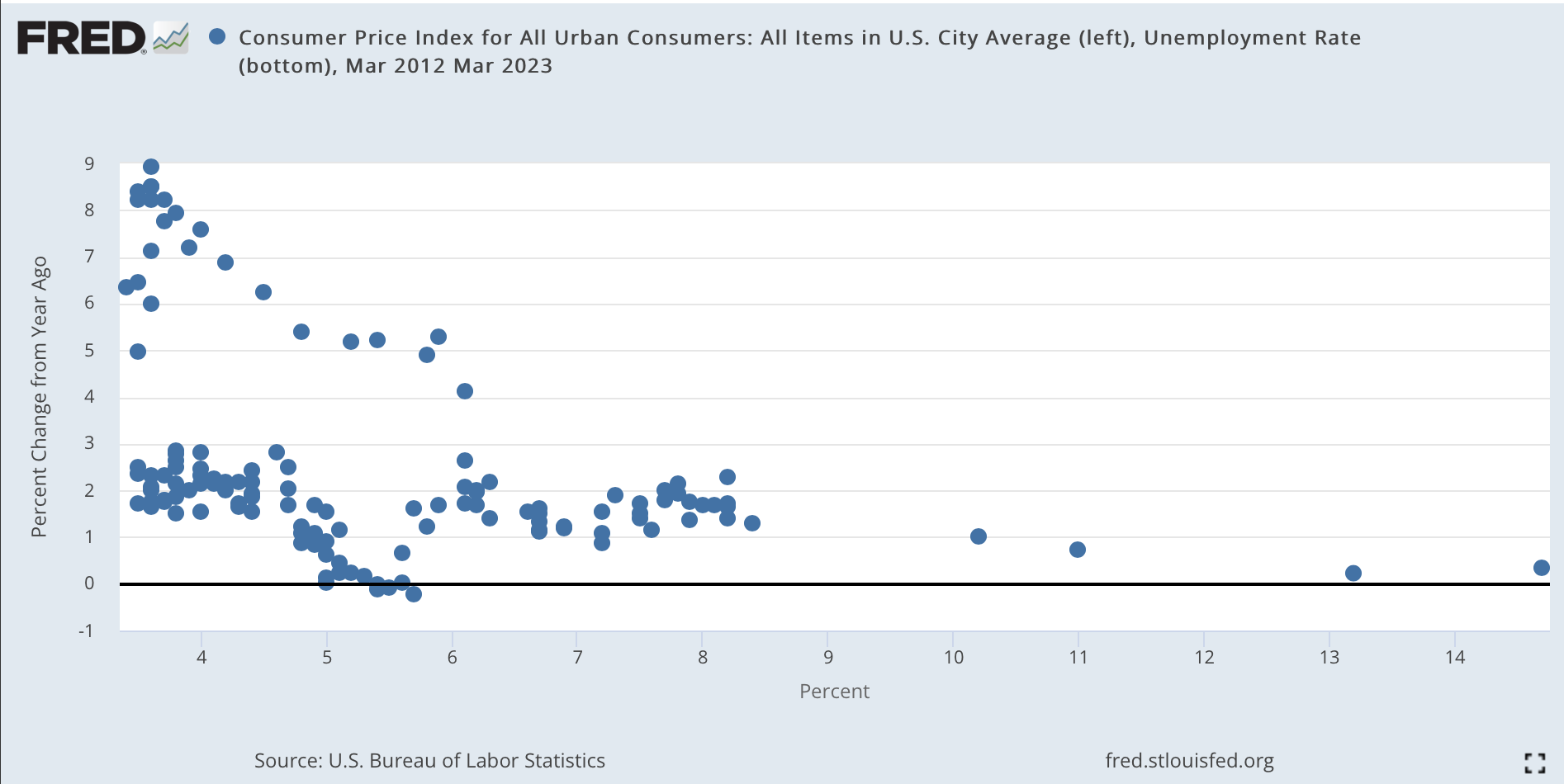
Here is the Phillips curve (unemployment x axis, inflation y axis) from 2012 through last month. The dots on the lower branch are the pre-covid curve, "flat" as common wisdom proclaimed. Inflation was still 2% with unemployment 3.5% on the eve of the pandemic. The upper branch is the more recent experience. 

I think this plot makes some sense of the Fed's colossal failure to see inflation coming, or to perceive it once the dragon was inside the outer wall and breathing fire at the inner gate. If you believe in a Phillips Curve, causal from unemployment (or "labor market conditions") to inflation, and you last saw 3.5% unemployment with 2% inflation in February 2021, the 6% unemployment of March 2021 is going to make you totally ignore any inflation blips that come along. Surely, until we get well past 3.5% unemployment again, there's nothing to worry about. Well, that was wrong. The curve "shifted" if there is a curve at all. 

But what to put in its place? Good question. 

Update:

Lots of commenters and correspondents want other Phillips Curves. I've been influenced by a number of papers, especially "New Pricing Models, Same Old Phillips Curves?" by Adrien Auclert, Rodolfo Rigato, Matthew Rognlie, and Ludwig Straub, and "Price Rigidity: Microeconomic Evidence and Macroeconomic Implications" by Emi Nakamura and  Jón Steinsson, that lots of different micro foundations all end up looking about the same. Both are great papers. Adding lags seems easy, but it's not that simple unless you overturn the forward looking eigenvalues of the system; "Expectations and the neutrality of interest rates" goes on in that way. Adding a lag without changing the system eigenvalue doesn't work. 

Sabtu, 04 Maret 2023

Economic Journal Home Bias

Home Bias in Economics Journals is an interesting new paper by Dirk Bethmann, Felix Bransch, Michael Kvasnicka, and Abdolkarim Sadrieh (via Marginal Revolution).

...Researchers from Harvard, but also nearby Massachusetts Institute of Technology (MIT), and from Chicago (co-)author a disproportionate share of articles in their respective home journal.... We study this question in a difference-in-differences framework, using data on both current and past author affiliations and cumulative citation counts for articles published between 1995 and 2015 in the QJE, JPE, and American Economic Review (AER), which serves as a benchmark. We find that median article quality is lower in the QJE if authors have ties to Harvard and/or MIT than if authors are from other top-10 universities, but higher in the JPE if authors have ties to Chicago. We also find that home ties matter for the odds of journals to publish highly influential and low impact papers. Again, the JPE appears to benefit, if anything, from its home ties, while the QJE does not. 

On the bottom end as well, 

articles with a Chicago aliation in the JPE are less likely to be amongst the group of relatively low impact articles (i.e., to rank among the 25% or 10% of least cited articles published in the three journals in a year) than articles in the JPE authored by researchers from other top-10 institutions. 

Those are the what, but not the why. These findings naturally provoke some thought from my time at Chicago, and as JPE editor. 

While I was at the JPE there was an explicit ethic about these matters. Yes, the JPE  publishes papers by Chicago faculty, but only the best ones.  Faculty were expected to self-select the best papers, especially innovative ones that have trouble elsewhere, but are likely to have impact t. That ethic was even stronger for Chicago PhD dissertations. The JPE really really discouraged Chicago Ph.D. dissertations, and only very rarely published them. (I'm curious how much of the JPE/QJE difference comes down to dissertations rather than faculty papers). 

When I was there, there were only four editors, all based at Chicago. There was also a rule that a second editor had to sign off on any revision and on any publication decision. This was wonderful discipline, and I learned a lot from my fellow editors' view of papers. That procedure also helps to enforce the higher bar standard. All being from the same institution helped a well to produce collegiality, as well as interest in keeping up the brand. 

Some of my hardest times as editor came from rejecting colleagues' pretty good but not good enough papers. For colleagues, I also was strict about the one revision rule, and rejecting a few promising but still not ready papers from colleagues (and friends) caused more heartache.

The JPE also had a culture of decisive editing. The referees provide advice, but the editor makes decisions. This culture leads to publishing the kind of innovative papers that referees may disparage,  especially when an author crosses field boundaries and invades sensitive turf. 

In this way a home journal, run by a small number of long-term editors, with an institutional reputation, is different than an association journal, with a large board of coeditors who serve short times, and act independently.  

I benefited from the JPE's policies. Sherwin Rosen published "Time consistent health insurance" over referee objections, though of course asking for a revision that addressed those objections. "The Random Walk in GNP," my first big paper, was published in the JPE after being rejected elsewhere. "Determinacy and Identification," a sprawling new-Keynesian critique, could never have been published anywhere else. "A simple test of consumption insurance" (as well as Barb Mace's "Full Insurance" which inspired my paper, a worthy exception to the rule against PhD theses) would likely have had a terrible time anywhere else. John Campbell and I might have published By Force of Habit elsewhere,  but the JPE editor was important to boiling it down and focusing it. 

Was it a good idea for the JPE to publish these, or would the world be better if half had spent another few years batting from journal to journal, and half ended up not published at all? Of course, perhaps there were  other, better, papers from outsiders that the JPE could have published. You judge. 

I also have plenty of papers rejected by the JPE, even desk rejected. And most of my papers get rejected by at least 3 or 4 journals before finding a home. Welcome to the club. 

Things have changed. The JPE is a much bigger journal, with a big and spread out editorial board. Other journals, like the AER, have also expanded and added sub journals. Perhaps the concept of a small general interest journal, run by decisive editors willing to take some risk in the quest of innovative papers, publishing papers that at least two of four editors can understand and judge, is out of date; nostalgia for a simpler time.  I hope the new JPE retains the special character that made the old JPE so good. 


Kamis, 02 Maret 2023

Lessons from Sargent and Leeper

At the AEI fiscal theory event last Tuesday Tom Sargent and Eric Leeper made some key points about the current situation, with reference to lessons of history. 

Tom's comments updated his excellent paper with George Hall "Three World Wars" (at pnas,  summary essay in the Hoover Conference volume). Tom and George liken covid to a war: a large emergency requiring immense expenditure. We can quibble about "require" but not the expenditure. 


(2008 was a little war in this sense as well.) Since outlays are well ahead of receipts, these huge temporary expenditures are financed by issuing debt and printing money, as optimal tax theory says they should be. 

In all three cases, you see a ratcheting up of outlays after the war. That's happening now, and in 2008, just as in WWI and WWII. 

After WWI and WWII, there is a period of primary surpluses -- tax receipts greater than spending -- which helps to pay back the debt. This time is notable for the absence of that effect. 


We see that most clearly by plotting the primary deficits directly. The data update since Tom and George's original paper (dots) makes that clear. To a fiscal theorist, this is a worrisome difference. We are not following historical tradition of regular, full employment, peacetime surpluses. 


The two world wars were also financed by a considerable inflation. The important consequence of inflation is that it inflates away government debt. Essentially, we pay for part of the war by a default on debt, engineered via inflation. 

1947 is an interesting case. As now, inflation broke out, the Fed left interest rates alone, and the inflation went away once it had inflated away enough debt. That too is an interesting episode in the debate whether the Fed must move rates more than one for one to keep inflation from spiraling away. 

The effect of inflation is clearer in the next graph, which plots the real return on government bonds: 


Yes, the inflation of 1920 did inflate away a lot of the WWI debt, though the deflation of 1921 brought a lot of that back. (This is an episode we would do well to remember more! The price level doubled from 1916 through 1920. It then retreated by a third in 1920-1921. There was a sharp recession, but the economy recovered very quickly with no stimulus or heroic measures. The conventional wisdom that wringing out WWI inflation caused the UK 1920s doldrums needs to consider this counterexample. But back to our point) 

This is also consistent with standard optimal tax theory, which says that in the event of a disaster that happens once every 50 years or so, it is right to execute a "state contingent default" (Lucas and Stokey), and inflation is a natural way to do it. 

But... "state contingent default" is supposed to happen at the beginning of a war. These inflations happened at the end of the war. How did governments sell bonds to people who should have expected them to be inflated away? Yes, there were some price controls and financial repression, but it's still an important puzzle to standard public finance theory.  

My concern, of course, is that we've had two once in a hundred year events in a row (2008, 2020), I can think of lots more that might come soon, and you can only do this occasionally. Hit people over the head a few too many times and they start to duck. We will head to the next crisis with no history of steady surpluses in good times, 100% debt to GDP ratio, and a painful reminder of what happens if you lend to the US right in the rear view mirror. 


We start the H5N1/Taiwan war crisis with the same debt we had at the end of WWII. And who owns the debt leads to some fascinating speculation which I'll let you fill in with your chat GPT.  

Tom closed by echoing my favorite bright idea for avoiding the debt limit: Since the limit applies to par value not market value, the Treasury can issue all the perpetuities it wants. That's far better than the trillion dollar coin, though I suspect the Supreme Court would take just as dim a view of it. 

Eric  brought up a great point from his super Recovery of 1933 paper with Margaret Jacobson and Bruce Preston. 
In 1933, we had a disastrous deflation. The gold standard is a lovely fiscal commitment device to try to contain inflation, but it has an Achilles heel. If there is a deflation, the government has to raise taxes to pay an unexpected real windfall to bondholders. In 1933, the Roosevelt Administration abrogated the gold standard. It was a default on the legal terms of the bonds. And look what happened to inflation! 

Eric also brought up a second central point of his 1933 paper: The Roosevelt Administration separated the budget into a "regular" budget, in which we should expect deficits to be paid back, and an "emergency" budget, unbacked (in our language) by expected surpluses. That cleverly allowed inflationary finance in 1933, but once the "emergency" was over in 1941, it preserved the US reputation for repaying wartime debts with subsequent surpluses, and allowed it to borrow for WWII. This loss of "back to normal," of expectations that we are now in "regular" not "emergency" finance is worrisome today. 

Finally, Eric brought some nice evidence to bear on the question, why 2020 but not 2008? Well, in part, we can look at statements of public officials. In 2008, they explicitly said, deficit now, repayment later. In 2020 they explicitly said the opposite. 

("Offsets" is Washington-speak for "taxes" or later spending cuts.) Don't read a pejorative in this analysis. If you want to borrow, finance crisis expenditures and not create inflation, you "maintain the norm." If you want to create a "state contingent default" and pay for crisis expenditures by inflating away debt, you have to "violate the norm." That is darn hard -- ask the Japanese. How do you convince people you're not going to repay some part of the debt, despite a good reputation, but just some part, and if WWII comes along you're good for additional debts? Well, announcing your intentions helps!  


And it worked. We very quickly inflated away the debt. Creating a state contingent default via inflation is not easy. Still to be seen though is whether we can return to "normal" "Hamilton norm" once it's over. 

Robert Barro also had great comments, but more directed at the book and with no great graphs to pass along. Thanks anyway!

Fiscal inflation and interest rates

Economics is about solving lots of little puzzles. At a July 4th party, a super smart friend -- not a macroeconomist -- posed a puzzle I sho...