ads1

Tampilkan postingan dengan label Taxes. Tampilkan semua postingan

Kamis, 25 Mei 2023

Work requirements

The debate over work requirements for social programs is hot and heavy. I'll chime in there as I don't think even the Wall Street Journal Editorial pages have stated the issue clearly from an economic point of view.  As usual, it's getting obfuscated in a moral cloud by both sides: How could you be so heartless as to force unfortunate people to work, vs. how immoral it is to subsidize indolence, and value of the "culture" of self-sufficiency. 

Economics, as usual, offers a straightforward value-free way to think about the issue: Incentives. When you put all our social programs together, low income Americans face roughly 100% marginal tax rates. Earn an extra dollar, lose a dollar of benefits. It's not that simple, of course, with multiple cliffs of infinite tax rates (earn an extra cent, lose a program entirely), and depends on how many and which programs people sign up for. But the order of magnitude is right. 

The incentive effect is clear: don't work (legally). As Phil Gramm and Mike Solon report, 

Since 1967, average inflation-adjusted transfer payments to low-income households—the bottom 20%—have grown from $9,677 to $45,389. During that same period, the percentage of prime working-age adults in the bottom 20% of income earners who actually worked collapsed from 68% to 36%.

36%. The latter number is my main point, we'll get to cost later. Similarly, the WSJ points to  a report by Jonathan Bain and Jonathan Ingram at the Foundation for Government Accountability that

there are four million able-bodied adults without dependents on food stamps, and three in four don’t work at all. Less than 3% work full-time.

3%. 

Incentives are a budget constraint to government policy, hard and immutable. Your feelings about people one way or another do not move the incentives at all. A gift of money with an income phase-out leads people to work less, and to require more gifts of money.  That's just a fact. 

What to do? 

One answer is, remove the income phaseouts. Give food stamps, medicaid, housing subsidies,  earned income tax credits, and so forth, to everyone, and don't reduce them with income. Then the disincentive to work is much reduced. (There is still the "income effect," but in my judgement that's a lot smaller for most people in this category.) 

Rather obviously, that's impractical. Even the US, even if r<g or MMT are true, would run out of money quickly. That's the problem with Universal Basic Income. Even $20,000 x 331 million = $6.6 trillion, essentially the entire federal budget right there, and $20,000 of total support is a lot less than people with $0 income get right now. (Gramm, Ekelund and Early, and Casey Mulligan estimate about $60,000 is the right number here.)  Put another way, to eliminate the work disincentive in the social programs, we would have to jack up marginal tax rates on everyone to such stratospheric levels that nobody works. You can't escape disincentives. 

So, support for the unfortunate must be limited somehow. That's why we limit it to people below a certain income level. But even if each individual program maintains a reasonable marginal phaseout, they add up across programs, and next thing you know we're back to 100% phase out. 

Posit that work is still desirable,  to earn some money, to contribute to your fellow citizens, to reduce the need for income assistance, and to build human capital.  (Plus the more ephemeral goals all sides of the debate ascribe to work -- self reliance, life meaning, self-respect, participation in society, and so forth. I promised no moral or sociological arguments, but these values being shared by both sides of the debate, I can make a little exception. Nobody thinks that an entire lifetime of living on a government check, doing nothing but drink take drugs and play video games all day, makes for a desirable society, no matter who they vote for.)  

If so, if the social safety net creates a 100% marginal tax rate on work, and if abandoning income phaseouts will bankrupt the state, then we have a problem. 

Work requirements are an imperfect method to try to replace the incentive to work that social programs eliminate. Our government does this sort of thing all over to transfer income but contain the disincentives: Subsidize gas, and then regulate against its use for example. 

It is inefficient, as you can tell from the brouhaha. It's much more efficient to get people to work by saying "if you earn a dollar, you can keep it," rather than "if you earn a dollar we'll take it away from you but we're going to force you to work." As the WSJ details here and often, the rules are complex, and people and governments game them. Just who should work? Progressives will quickly find a sick single mother taking care of elderly parents and commuting to some horrible fast food job who falls through the cracks, and they are right. Rules and bureaucracies are very rough substitutes for market incentives. More importantly, if you're working for money, you find the best job you can, you work hard, you look for better opportunities. If you're working to satisfy a bureaucratic work requirement in the face of a 100% tax rate, you find the easiest job you can, you don't care about the money and thereby the social productivity of the work, and you do as little as possible. 

So I'm not defending work requirements as a perfect offset to a 100% marginal tax rate. But they are there for a reason, as a very rough offset to some of the huge disincentives that means-tested programs pose. The point today is that we should start to understand and debate work requirements in this framework. If you're going to remove market incentives, you need some replacement. 

By the way, supposedly socialist Europe, after its experience with "the dole" in the early 1990s, is much more heard-hearted about these sorts of incentives than we are. Progressives who think we should both emulate nordic countries and also expand our safety net should go look at nordic countries. 

Is there a better way? I've long played with the idea of limiting help by time rather than by income. That's how unemployment insurance works. We understand that replacing people's paycheck forever if they lose their job has bad incentive effects. Unemployment is understood as a temporary misfortune, and understanding the incentives, you get unemployment checks for a limited amount of time. Could not many other programs aimed at misfortune also be limited by time -- but then allow you to keep each extra dollar of earnings? Perhaps even unemployment should be a fixed amount of time, and you can keep receiving it for the full (normally) 26 weeks even if you get a job. 

The trouble with that, of course, is that some people will not get their acts together in the required time, and then you have to be heartless. But is it not just as heartless to say to a person who had been on food stamps, earned income tax credit, social security disability and housing voucher, "well, congrats on getting  a job, and a good one, that pays $60,000 per year. Now we're taking away all your benefits. Enjoy the $1?" 

Also, the safety net does include a detailed bureaucracy to determine who is needy. Disability, unemployment, and so forth look hard at these issues. Replicating that with a different set of rules for each program seems mighty wasteful. 

Another wild idea: Good economists all understand that consumption, not income, is the right measure of well being. That's why consumption taxes are a good idea, and we should measure consumption diversity not income diversity. (I don't use the word "inequality" anymore as it prejudices the right answer.) One advantage of a consumption tax is that it would be easier to condition benefits on consumption rather than income. If you work and save the results, you can keep your benefits. 

One last point, which maybe should be the first point. It is a bit scandalous that income phase outs in social programs take away benefits based on market income, but not social program income. If you have food stamps and earn an extra $10,000 of income, you can lose your foods stamps. If you get housing worth $10,000, you don't lose anything. Ditto in the entire social program system. This is an immense distortion towards putting effort into obtaining more social programs rather than working. Phasing out based on consumption, including cash and non cash benefits, would make a lot more sense. But one could phase out benefits based on which other benefits you receive too. Disincentives come from the social program and tax system overall, and any hope of continuing disincentives and saving money must take a similar integrated system approach. 

The argument also is over how much money the programs cost. That leads to "how could you be so heartless" vs. "but the country will go broke," also going nowhere. A focus on incentives offers the way out. Fix the incentives, and we end up helping people who need it a lot better, we end up with a lot fewer people who need help, and spend a lot less money. Win win win. 

There is no clean answer. A main lesson of economics is that there is always a tradeoff between help and disincentives, between insurance and moral hazard. We can make this tradeoff a lot more efficient than it is, but we can't totally eliminate the tradeoff. 

The bottom line remains, this discussion would be a lot more productive discussion if we talked about the constraint posed by incentives, rather than the usual moral mudslinging.    

Update:

So work requirements are a little tightened, but not if you have Medicaid. WTF? Medicaid is limited by income. The incentive spaghetti here would be fun to unravel. Of course, we have an  additional reason to stay below the income cap for Medicaid. We have an additional incentive to sign up for Medicaid, which may be the idea here. "Get a job, lose your food stamps, or sign up for this free government program." Hmm. Feel free to riff on this one in the comments... 


Kamis, 02 Maret 2023

Fair tax full text

From the Wall Street Journal Feb 2. After 30 days I can post full text. 

A Consumption Tax Is the Shock Our Broken System Needs

Something remarkable happened last month. On Jan. 9, Georgia Rep. Buddy Carter introduced the “Fair Tax” bill to the House of Representatives, and secured a promise of a floor vote. The bill eliminates the personal and corporate income tax, estate and gift tax, payroll (Social Security and Medicare) tax and the Internal Revenue Service. It replaces them with a single national sales tax. Business investment is exempt, so it is effectively a consumption tax. Each household would get a check each month, so that purchases up to the poverty line are effectively not taxed.

Mainstream media and Democrats instantly deplored the measure. Mother Jones said it would “turbocharge inequality.” Rep. Pramila Jayapal called it a “tax cut for the rich, period.” The New Republic asserted that consumption taxes are “always a dumb idea”—but presumably not in Europe, where 20% value-added taxes finance welfare states—and called it a “Republican dream to build a wealth aristocracy.”

Even the Journal’s editorial board disapproved, though mostly on politics rather than substance, admitting a consumption tax “might make sense” if Congress were “writing the tax code from scratch.” The board worried that we might end up with income and sales taxes, like Europe. And the tax change won’t pass, making it is a “masochistic vote” that it will “give Democrats a potent campaign issue.”

But our income and estate tax system is broken. It has high statutory rates with a Swiss cheese of exemptions, immense cost, unfairness and distortion. Former President Trump’s taxes are Exhibit A, no longer making headlines because we learned that he simply aggressively exploits the complex rules and deductions that Congress offers to wealthy politically connected real-estate investors.

A consumption tax, with none of the absurd complexity of our current taxes, is the answer. It funds the government with the least economic distortion. A consumption tax need not be regressive. It’s easy enough to exempt the first few thousand dollars of consumption, or add to the rebate.

More important, the progressivity of a whole tax and transfer system matters, not of a particular tax in isolation. If a flat consumption tax finances greater benefits to people of lesser means, the overall system could be more progressive than what we have now. A consumption tax would still finance food stamps, housing, Medicaid, and so forth. And it would be particularly efficient at raising revenue, meaning there would potentially be more to distribute—a point that has led some conservatives to object to a consumption tax.

Others complain that the rate will be high. An effective 30% consumption tax, added to state sales taxes as high as 10%, could add up to a 40% or greater rate. But taxes overall must finance what the government spends. Collecting it in one tax rather than lots of smaller taxes doesn’t change the overall rate. It’s better for voters to see how much the government takes.

A range of implicit subsidies will disappear. Good. Subsidies should be transparent. Money for electric cars, health insurance, housing, and so forth should be appropriated and sent as checks, not hidden as tax deductions or credits. They can still be as large as Congress and voters wish. However, it is vital to keep the tax at a flat rate and not try to redistribute income or subsidize industries by different tax rates.

Will there be some problems of compliance and evasion? Probably, but sales taxes or value-added taxes are hardly new, untested ideas. The Fair Tax bill addresses many objections and real-world concerns, and more refinements can follow. A value-added tax or personal-consumption tax can achieve similar goals.

This is a big moment. For a long time, consumption taxes have been debated in academic articles, books, think-tank reports, administration white papers and so forth. When the U.S. eventually decides to reform the tax code, consumption taxes will be the obvious answer. It is great news that real elected politicians like Rep. Carter get it, and are willing to stick their necks out to try to get it passed.

No, it’s not likely to pass this year, or next. All great reforms take time. The 8-hour workday and Social Security started as wild-eyed dreams of the socialist party. Civil rights took bill after bill being voted down. The income tax took a long time. But if we never talk about the promised land and only squabble over the next fork in the road, surely we will never get there.


Lessons from Sargent and Leeper

At the AEI fiscal theory event last Tuesday Tom Sargent and Eric Leeper made some key points about the current situation, with reference to lessons of history. 

Tom's comments updated his excellent paper with George Hall "Three World Wars" (at pnas,  summary essay in the Hoover Conference volume). Tom and George liken covid to a war: a large emergency requiring immense expenditure. We can quibble about "require" but not the expenditure. 


(2008 was a little war in this sense as well.) Since outlays are well ahead of receipts, these huge temporary expenditures are financed by issuing debt and printing money, as optimal tax theory says they should be. 

In all three cases, you see a ratcheting up of outlays after the war. That's happening now, and in 2008, just as in WWI and WWII. 

After WWI and WWII, there is a period of primary surpluses -- tax receipts greater than spending -- which helps to pay back the debt. This time is notable for the absence of that effect. 


We see that most clearly by plotting the primary deficits directly. The data update since Tom and George's original paper (dots) makes that clear. To a fiscal theorist, this is a worrisome difference. We are not following historical tradition of regular, full employment, peacetime surpluses. 


The two world wars were also financed by a considerable inflation. The important consequence of inflation is that it inflates away government debt. Essentially, we pay for part of the war by a default on debt, engineered via inflation. 

1947 is an interesting case. As now, inflation broke out, the Fed left interest rates alone, and the inflation went away once it had inflated away enough debt. That too is an interesting episode in the debate whether the Fed must move rates more than one for one to keep inflation from spiraling away. 

The effect of inflation is clearer in the next graph, which plots the real return on government bonds: 


Yes, the inflation of 1920 did inflate away a lot of the WWI debt, though the deflation of 1921 brought a lot of that back. (This is an episode we would do well to remember more! The price level doubled from 1916 through 1920. It then retreated by a third in 1920-1921. There was a sharp recession, but the economy recovered very quickly with no stimulus or heroic measures. The conventional wisdom that wringing out WWI inflation caused the UK 1920s doldrums needs to consider this counterexample. But back to our point) 

This is also consistent with standard optimal tax theory, which says that in the event of a disaster that happens once every 50 years or so, it is right to execute a "state contingent default" (Lucas and Stokey), and inflation is a natural way to do it. 

But... "state contingent default" is supposed to happen at the beginning of a war. These inflations happened at the end of the war. How did governments sell bonds to people who should have expected them to be inflated away? Yes, there were some price controls and financial repression, but it's still an important puzzle to standard public finance theory.  

My concern, of course, is that we've had two once in a hundred year events in a row (2008, 2020), I can think of lots more that might come soon, and you can only do this occasionally. Hit people over the head a few too many times and they start to duck. We will head to the next crisis with no history of steady surpluses in good times, 100% debt to GDP ratio, and a painful reminder of what happens if you lend to the US right in the rear view mirror. 


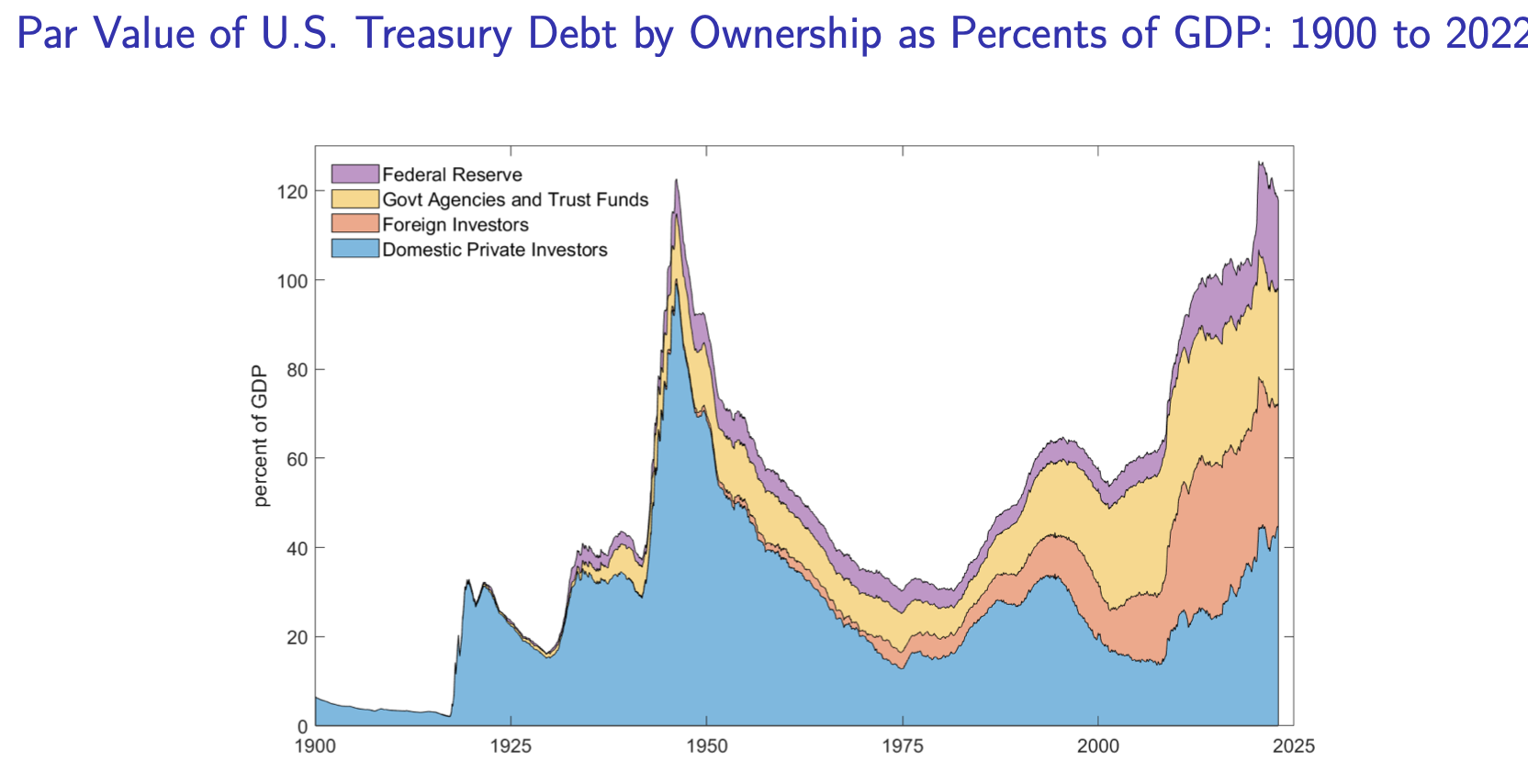
We start the H5N1/Taiwan war crisis with the same debt we had at the end of WWII. And who owns the debt leads to some fascinating speculation which I'll let you fill in with your chat GPT.  

Tom closed by echoing my favorite bright idea for avoiding the debt limit: Since the limit applies to par value not market value, the Treasury can issue all the perpetuities it wants. That's far better than the trillion dollar coin, though I suspect the Supreme Court would take just as dim a view of it. 

Eric  brought up a great point from his super Recovery of 1933 paper with Margaret Jacobson and Bruce Preston. 
In 1933, we had a disastrous deflation. The gold standard is a lovely fiscal commitment device to try to contain inflation, but it has an Achilles heel. If there is a deflation, the government has to raise taxes to pay an unexpected real windfall to bondholders. In 1933, the Roosevelt Administration abrogated the gold standard. It was a default on the legal terms of the bonds. And look what happened to inflation! 

Eric also brought up a second central point of his 1933 paper: The Roosevelt Administration separated the budget into a "regular" budget, in which we should expect deficits to be paid back, and an "emergency" budget, unbacked (in our language) by expected surpluses. That cleverly allowed inflationary finance in 1933, but once the "emergency" was over in 1941, it preserved the US reputation for repaying wartime debts with subsequent surpluses, and allowed it to borrow for WWII. This loss of "back to normal," of expectations that we are now in "regular" not "emergency" finance is worrisome today. 

Finally, Eric brought some nice evidence to bear on the question, why 2020 but not 2008? Well, in part, we can look at statements of public officials. In 2008, they explicitly said, deficit now, repayment later. In 2020 they explicitly said the opposite. 

("Offsets" is Washington-speak for "taxes" or later spending cuts.) Don't read a pejorative in this analysis. If you want to borrow, finance crisis expenditures and not create inflation, you "maintain the norm." If you want to create a "state contingent default" and pay for crisis expenditures by inflating away debt, you have to "violate the norm." That is darn hard -- ask the Japanese. How do you convince people you're not going to repay some part of the debt, despite a good reputation, but just some part, and if WWII comes along you're good for additional debts? Well, announcing your intentions helps!  


And it worked. We very quickly inflated away the debt. Creating a state contingent default via inflation is not easy. Still to be seen though is whether we can return to "normal" "Hamilton norm" once it's over. 

Robert Barro also had great comments, but more directed at the book and with no great graphs to pass along. Thanks anyway!

Fiscal inflation and interest rates

Economics is about solving lots of little puzzles. At a July 4th party, a super smart friend -- not a macroeconomist -- posed a puzzle I sho...